Understanding the nuances between B2B (business-to-business) and B2C (business-to-consumer) business models is crucial for success in today’s diverse marketplace. While both involve selling goods or services, their target audiences, marketing strategies, and operational approaches differ significantly. This exploration delves into these key distinctions, providing a comprehensive overview of each model’s unique characteristics and challenges.
From sales cycles and customer relationship management to pricing strategies and ethical considerations, we will examine the critical aspects that shape the success of B2B and B2C ventures. By understanding these fundamental differences, businesses can tailor their strategies for optimal performance and sustainable growth within their chosen market.
Defining B2B and B2C Business Models
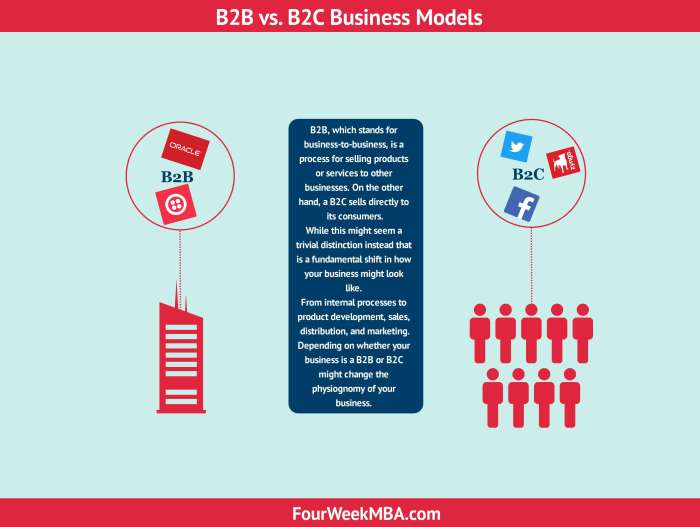
Business-to-business (B2B) and business-to-consumer (B2C) are two fundamental business models representing distinct approaches to market and sell products or services. Understanding their core differences is crucial for effective business strategy and marketing. This section will define each model, compare their characteristics, and highlight key distinctions in target audiences, marketing approaches, and sales processes.
Both B2B and B2C models aim to generate revenue through sales, but their methods, customer interactions, and overall strategies differ significantly. B2B focuses on selling products or services to other businesses, while B2C focuses on selling directly to individual consumers.
Core Characteristics of B2B and B2C Business Models
B2B businesses typically involve longer sales cycles, more complex transactions, and a greater emphasis on building long-term relationships. Sales often involve multiple decision-makers within the purchasing organization. Conversely, B2C businesses often feature shorter sales cycles, simpler transactions, and a focus on individual customer needs. Marketing strategies reflect these differences, with B2B focusing on building trust and demonstrating value through professional channels, while B2C emphasizes broader reach and direct consumer engagement.
Target Audience Differences
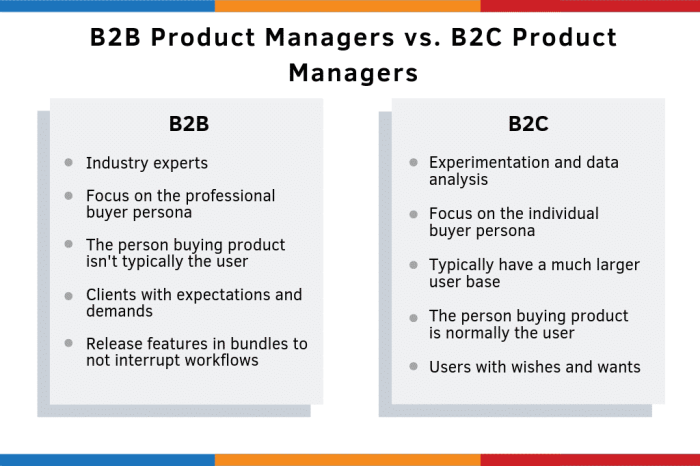
The target audience is a fundamental difference between B2B and B2C. B2B targets businesses, organizations, and institutions. This might include manufacturers, retailers, wholesalers, government agencies, or other businesses. The decision-making process is often more complex, involving multiple stakeholders and detailed evaluations. B2C, on the other hand, targets individual consumers who purchase goods or services for personal use.
Marketing efforts are tailored to individual preferences and purchasing behaviors. For example, a software company selling CRM solutions to businesses (B2B) will use a different marketing strategy than a company selling consumer electronics directly to individuals (B2C).
Marketing Strategies
B2B marketing often relies on content marketing, thought leadership, and professional networking. Building trust and demonstrating expertise are paramount. Marketing materials are typically more formal and data-driven, focusing on ROI and value propositions. B2C marketing, in contrast, often utilizes broader reach strategies such as social media marketing, advertising, and influencer collaborations. Emotional appeals and brand building are often more prominent.
A B2B company might publish white papers and case studies, while a B2C company might run targeted social media campaigns and television commercials.
Sales Cycle Differences
The sales cycle length is another significant distinction. B2B sales cycles are typically much longer and more complex, often involving multiple stages from initial contact to final sale. Negotiations are common, and building a strong relationship with the client is crucial. B2C sales cycles are generally shorter and simpler, with a quicker transition from initial contact to purchase.
For example, a B2B sale of industrial equipment could take months or even years, whereas a B2C purchase of clothing online might be completed within minutes.
Comparison Table: B2B vs. B2C
| Feature | B2B Description | B2C Description | Key Differences |
|---|---|---|---|
| Target Audience | Businesses, organizations, institutions | Individual consumers | Business vs. individual needs and purchasing processes |
| Sales Cycle | Longer, more complex, multiple decision-makers | Shorter, simpler, often single decision-maker | Length and complexity of the buying process |
| Marketing Strategies | Content marketing, thought leadership, professional networking | Social media, advertising, influencer marketing | Focus on building relationships vs. brand awareness and immediate sales |
| Pricing | Often negotiated, higher price points | Fixed prices, wider price range | Pricing models and negotiation strategies |
Sales and Marketing Strategies
B2B and B2C sales and marketing differ significantly due to the nature of their target audiences and the complexity of their sales cycles. B2B typically involves longer sales cycles, more complex decision-making processes, and a greater emphasis on building relationships, while B2C focuses on shorter sales cycles, simpler purchasing decisions, and broader reach. Understanding these differences is crucial for developing effective strategies.
Distinct Sales Approaches in B2B and B2C Environments
B2B sales often rely on a consultative approach, where sales representatives act as trusted advisors, understanding clients’ needs and offering tailored solutions. This involves building rapport, demonstrating expertise, and providing detailed proposals. In contrast, B2C sales frequently employ a transactional approach, focusing on quick sales and often utilizing various channels like e-commerce platforms, retail stores, and direct marketing. B2B sales teams might use tools like CRM software to manage leads and track interactions, whereas B2C might rely more on point-of-sale systems and customer relationship management (CRM) systems focused on individual customer interactions.
The sales process itself is longer and more complex in B2B, often involving multiple stakeholders and decision-makers, compared to the typically simpler, shorter process in B2C.
Examples of Successful Marketing Campaigns
A successful B2B marketing campaign might involve a series of webinars showcasing a company’s expertise, white papers demonstrating thought leadership, or targeted advertising on LinkedIn to reach specific professionals within a particular industry. For example, a software company might host a webinar on improving efficiency in a specific industry, providing valuable insights to potential clients and positioning themselves as a solution provider.
Conversely, a successful B2C campaign might utilize social media marketing, influencer collaborations, or engaging video advertisements to reach a wider audience. An example would be a clothing brand collaborating with a popular influencer on Instagram to showcase their new collection and drive sales through targeted ads and influencer marketing campaigns. These campaigns often leverage emotional appeals and focus on immediate gratification.
Comparison of Effective Marketing Channels
B2B marketing often relies on content marketing (blog posts, case studies, white papers), search engine optimization (), and professional networking sites like LinkedIn. Email marketing plays a significant role in nurturing leads and building relationships. Conversely, B2C marketing often leverages social media platforms like Facebook, Instagram, and TikTok, alongside paid advertising on search engines and social media, and email marketing, although the approach and content are tailored differently.
B2C businesses may also invest heavily in television or radio advertising to reach broader audiences. The effectiveness of each channel depends on the specific target audience and marketing objectives, but generally, B2B prioritizes channels that allow for targeted outreach to specific professionals and industries, while B2C prioritizes channels that offer broad reach and engagement with a wider consumer base.
Customer Relationship Management (CRM)
Effective Customer Relationship Management (CRM) is crucial for both B2B and B2C businesses, but the strategies and metrics employed differ significantly due to the nature of their customer interactions and sales cycles. Understanding these differences is key to optimizing customer relationships and maximizing business success.CRM strategies in B2B and B2C environments diverge primarily in their approach to customer interaction and relationship nurturing.
B2B relationships often involve longer sales cycles, multiple decision-makers, and a greater emphasis on building trust and long-term partnerships. In contrast, B2C interactions are frequently shorter, more transactional, and focused on individual customer needs and immediate satisfaction. This difference dictates the types of CRM tools and strategies used.
B2B and B2C CRM Strategy Differences
B2B CRM focuses on nurturing complex relationships with multiple stakeholders within an organization. Strategies often involve account-based marketing (ABM), personalized communication tailored to individual client needs and industry context, and meticulous tracking of interactions across various touchpoints. Conversely, B2C CRM emphasizes efficient handling of large customer bases, personalized recommendations based on purchase history and preferences, and swift responses to inquiries.
Automation and segmentation play a vital role in B2C CRM to manage the volume of customer interactions effectively. For instance, a B2B software company might use a CRM to track interactions with a potential client across multiple departments, while an e-commerce business might use its CRM to personalize email marketing campaigns based on customer browsing history.
Key Metrics for B2B and B2C CRM Success
The metrics used to assess CRM effectiveness also vary. In B2B, key performance indicators (KPIs) often include customer lifetime value (CLTV), average deal size, win rate, and sales cycle length. These metrics reflect the long-term nature of B2B relationships and the importance of large, sustained contracts. In B2C, metrics such as customer acquisition cost (CAC), customer churn rate, average order value (AOV), and customer satisfaction (CSAT) scores are more commonly used.
These KPIs highlight the importance of efficient customer acquisition, retention, and satisfaction in a high-volume, transactional environment. A high CLTV for a B2B SaaS company indicates strong customer retention and long-term profitability, while a low churn rate for a subscription-based B2C service signals high customer loyalty.
Essential CRM Features for B2B and B2C Businesses
Prioritizing specific CRM features depends heavily on the business model.
The following Artikels essential features for each:
- B2B CRM:
- Account Management: Comprehensive tools for managing multiple contacts and interactions within a single client account.
- Lead Scoring and Qualification: Sophisticated algorithms to prioritize high-potential leads and streamline sales processes.
- Sales Pipeline Management: Visual representation of the sales process to track progress and identify bottlenecks.
- Contract Management: Tools to manage contracts, renewals, and related documents.
- Reporting and Analytics: Detailed reporting on sales performance, customer engagement, and other key metrics.
- B2C CRM:
- Marketing Automation: Tools to automate email marketing, social media campaigns, and other marketing activities.
- Customer Segmentation: Ability to segment customers based on demographics, purchase history, and other criteria.
- Personalized Communication: Tools to create personalized messages and offers for individual customers.
- Order Management: Efficient tools to track orders, manage returns, and handle customer inquiries.
- Customer Support Ticketing: System for managing and tracking customer support requests.
Business Development in B2B and B2C
Business development, the process of identifying and cultivating opportunities to grow a business, takes on distinct characteristics depending on whether the target market is businesses (B2B) or consumers (B2C). While both models aim for expansion, their strategies, challenges, and opportunities differ significantly due to the nature of their customer relationships and market dynamics.Successful business development hinges on understanding these nuances and adapting strategies accordingly.
This section will explore the key differences in business development for B2B and B2C models, focusing on strategic partnerships and market research methodologies.
Strategic Partnerships in B2B and B2C Business Development
Strategic partnerships play a crucial, albeit different, role in B2B and B2C business development. In B2B, partnerships often involve collaborations with complementary businesses to expand market reach, access new technologies, or enhance service offerings. For example, a software company might partner with a consulting firm to offer integrated solutions to clients. This synergistic approach leverages each partner’s strengths, creating a more compelling value proposition for the target market.
In contrast, B2C partnerships frequently focus on brand building and reaching wider consumer audiences. A clothing brand might collaborate with a popular influencer to promote its products, leveraging the influencer’s established following to increase brand awareness and drive sales. While both models benefit from strategic alliances, the nature and objectives of these partnerships are tailored to the specific characteristics of each market.
Market Research in B2B and B2C Business Development
Market research methodologies differ significantly between B2B and B2C. B2B research often involves in-depth qualitative analysis, focusing on understanding the needs and challenges of specific business segments. This may involve conducting detailed interviews with key decision-makers, analyzing industry trends, and attending industry events. The goal is to identify the specific pain points a business solution addresses and tailor the value proposition accordingly.
B2C research, on the other hand, tends to be more quantitative, focusing on broader consumer trends and preferences. This often involves surveys, focus groups, and analyzing large datasets of consumer behavior. The aim is to identify broad market trends and segment the consumer base to effectively target marketing efforts. The scale and depth of research vary significantly, reflecting the different nature of the customer base and decision-making processes.
Challenges and Opportunities in B2B and B2C Business Development
| Feature | B2B Challenges | B2B Opportunities | B2C Challenges | B2C Opportunities |
|---|---|---|---|---|
| Sales Cycle | Longer sales cycles, complex decision-making processes | High-value contracts, strong customer relationships | Shorter sales cycles, quicker feedback loops | Large potential market, diverse marketing channels |
| Marketing | Targeted marketing efforts, building trust and credibility | Strong ROI from targeted campaigns, lasting customer relationships | Reaching a wide audience, brand building | Rapid scaling potential, leveraging digital marketing |
| Customer Acquisition | Requires strong networking and relationship building | Long-term customer loyalty, high customer lifetime value | Requires effective branding and marketing | High volume sales, diverse revenue streams |
| Competition | Often intense competition from established players | Opportunities for niche market penetration, innovation | High competition, rapid market changes | Rapid innovation, first-mover advantage |
Business Coaching for B2B and B2C
Business coaching, while sharing a common goal of improving performance, adapts significantly depending on whether the client operates within a Business-to-Business (B2B) or Business-to-Consumer (B2C) environment. The fundamental differences in market dynamics, customer interactions, and operational structures necessitate distinct coaching approaches and skill sets.Business coaching for B2B and B2C clients requires tailored strategies to address the unique challenges and opportunities presented by each model.
Effective coaching recognizes the differing needs and priorities, resulting in more impactful and sustainable improvements.
B2B Coaching Approaches
B2B coaching often focuses on strategic leadership, sales team development, and navigating complex organizational structures. Coaches work with executives and managers to improve operational efficiency, enhance strategic planning, and cultivate stronger client relationships. The coaching process emphasizes collaborative problem-solving, fostering a culture of continuous improvement within the organization. A key aspect is understanding the intricate dynamics of B2B sales cycles, including lead generation, proposal development, and contract negotiation.
For example, a coach might help a B2B SaaS company refine its sales process to improve conversion rates by focusing on demonstrating value proposition and addressing client pain points effectively.
B2C Coaching Approaches
In contrast, B2C coaching frequently centers on brand building, customer experience enhancement, and optimizing marketing strategies. Coaches work closely with business owners and managers to improve customer acquisition, retention, and overall satisfaction. A core component is understanding consumer behavior, market trends, and the effectiveness of various marketing channels. For instance, a coach might assist a B2C e-commerce business in improving its website design to enhance user experience, or refine its social media strategy to reach a wider target audience and increase sales.
Key Skills and Expertise for B2B Coaching
Effective B2B coaching demands a deep understanding of business strategy, organizational development, and sales management. Coaches need strong analytical skills to interpret complex data, identify areas for improvement, and develop tailored solutions. They also require exceptional communication and interpersonal skills to build rapport with executives and manage diverse teams. Experience in navigating corporate hierarchies and understanding organizational politics is highly beneficial.
Expertise in areas like financial analysis, supply chain management, and project management can significantly enhance the coaching process.
Key Skills and Expertise for B2C Coaching
Successful B2C coaching requires a strong grasp of marketing principles, consumer psychology, and brand management. Coaches must possess excellent communication and creative thinking skills to develop effective marketing campaigns and engage target audiences. Understanding market research methodologies, data analytics, and social media marketing is crucial. A strong understanding of customer service principles and techniques for building customer loyalty is also essential.
For example, expertise in digital marketing and e-commerce best practices can significantly benefit the coaching process.
Benefits of Tailored Coaching Programs for B2B Businesses
Tailored coaching programs for B2B businesses lead to improved operational efficiency, increased profitability, and enhanced competitive advantage. Specifically, they help organizations refine their strategic direction, strengthen their sales processes, and cultivate a high-performing culture. This translates into better client relationships, improved employee engagement, and ultimately, sustained business growth. A tailored program allows for a more targeted approach, addressing the unique challenges and opportunities faced by the specific business.
Benefits of Tailored Coaching Programs for B2C Businesses
For B2C businesses, tailored coaching programs result in stronger brand recognition, increased customer loyalty, and improved sales conversion rates. By focusing on enhancing the customer experience and optimizing marketing strategies, these programs contribute to increased revenue, improved market share, and sustainable business growth. A personalized approach ensures that the coaching aligns with the specific needs and goals of the individual business, leading to more impactful results.
Business Loans and Financing
Securing funding is crucial for both B2B and B2C businesses, but the types of loans and financing options, as well as the lender’s evaluation process, differ significantly. Understanding these nuances is essential for entrepreneurs seeking to grow their ventures. This section will explore the key differences in accessing business loans and financing for B2B and B2C models.
Types of Business Loans and Financing for B2B and B2C Companies
B2B and B2C companies have access to a range of financing options, although their suitability varies depending on the business model, financial history, and the intended use of funds. B2B companies often require larger loans to support inventory, equipment purchases, or expansion projects, while B2C businesses might focus on smaller loans for working capital or marketing campaigns. Both can utilize various financing methods.
For example, a B2B software company might seek a term loan to fund research and development, whereas a B2C e-commerce business might leverage a line of credit to manage seasonal inventory fluctuations. Other options include SBA loans (available to both), invoice financing (more common in B2B), and merchant cash advances (more prevalent in B2C).
Factors Lenders Consider When Evaluating Loan Applications
Lenders assess several key factors when evaluating loan applications, although the emphasis may differ between B2B and B2C businesses. For B2B companies, factors like contract length and value with existing clients, industry stability, and demonstrated profitability are often heavily scrutinized. Lenders want to see a stable revenue stream and strong relationships with established clients. In contrast, B2C lenders often focus on sales trends, customer acquisition costs, and the overall market size.
The profitability of a B2C business can be evaluated based on factors like customer lifetime value and repeat purchase rates. Both B2B and B2C applicants are evaluated on their management team’s experience and credit history.
Impact of Credit Scores and Financial Statements on Securing Funding
A strong credit score and well-prepared financial statements are critical for securing funding, regardless of the business model. A high credit score indicates responsible financial management and reduces the perceived risk for lenders. Financial statements, including income statements, balance sheets, and cash flow statements, provide a detailed picture of the company’s financial health. For B2B companies, demonstrating consistent revenue growth and a healthy profit margin is crucial.
For B2C businesses, strong sales figures, efficient inventory management, and a positive cash flow are vital. Weak credit scores or poorly presented financial statements can significantly reduce the chances of securing a loan, regardless of whether the business is B2B or B2C. A well-structured business plan that clearly articulates the business model, financial projections, and use of funds also plays a crucial role in the lender’s decision-making process.
Business Model Innovation
Business model innovation is the process of creating and implementing new business models that significantly alter how a company creates, delivers, and captures value. This is crucial for sustained growth and competitiveness in today’s rapidly evolving market landscape, affecting both B2B and B2C businesses equally. Companies that fail to adapt risk becoming obsolete.
Innovative B2B Business Models
Several B2B companies have successfully implemented innovative business models. One example is the subscription model, where businesses offer ongoing access to software, services, or resources for a recurring fee. This predictable revenue stream allows for better financial planning and stronger customer relationships. Another example is the platform business model, exemplified by companies like Salesforce, which provide a platform for other businesses to build applications and services upon, creating a vast ecosystem and generating revenue through commissions or fees.
These models represent a shift away from traditional transactional sales.
Innovative B2C Business Models
The B2C sector has also witnessed significant business model innovation. The rise of the “sharing economy” epitomized by companies like Airbnb and Uber, disrupted traditional industries by connecting individuals directly, creating value through access rather than ownership. Subscription boxes, catering to diverse interests and needs with curated products delivered regularly, are another successful example. These models leverage technology to improve efficiency and personalization.
Additionally, the direct-to-consumer (DTC) model, bypassing traditional retail channels, offers brands greater control and closer customer relationships.
Factors Driving B2B Business Model Innovation
Several factors drive innovation in B2B business models. Increasing competition forces companies to find new ways to differentiate themselves and offer superior value propositions. Technological advancements, particularly in areas like cloud computing and artificial intelligence, create opportunities for new service offerings and improved operational efficiency. Changing customer expectations, demanding more personalized and integrated solutions, also push B2B companies to innovate.
Furthermore, globalization and the increasing complexity of supply chains necessitate more agile and adaptable business models.
Factors Driving B2C Business Model Innovation
Similar to B2B, competition and technological advancements are key drivers of B2C business model innovation. However, changing consumer behavior and preferences play an even more significant role. Consumers are increasingly demanding personalized experiences, seamless omnichannel integration, and sustainable and ethical practices. The rise of social media and mobile technology has empowered consumers and altered their expectations regarding purchasing and customer service.
Globalization and the increasing availability of information also contribute to a more informed and demanding consumer base.
Impact of Technology on B2B Business Model Evolution
Technology is fundamentally reshaping B2B business models. Cloud computing has enabled the rise of Software-as-a-Service (SaaS) and Platform-as-a-Service (PaaS) models, fostering collaboration and flexibility. Big data analytics provides valuable insights into customer behavior, enabling better targeting and personalization of services. Artificial intelligence (AI) and machine learning are automating processes and improving efficiency, allowing for more focused strategic decision-making.
These technological advancements facilitate the development of more agile and scalable business models.
Impact of Technology on B2C Business Model Evolution
Technology’s impact on B2C business models is equally profound. E-commerce platforms have revolutionized retail, offering consumers unprecedented choice and convenience. Mobile technology has enabled personalized marketing and location-based services. Social media platforms have created new channels for customer engagement and brand building. The Internet of Things (IoT) is creating opportunities for personalized and connected experiences.
These technological advancements have led to the emergence of new business models that prioritize customer experience and personalization.
Business Strategy and Planning
Strategic planning is crucial for any business, but the specifics differ significantly between B2B (business-to-business) and B2C (business-to-consumer) models. While both require a clear understanding of the market and competitive landscape, the nature of customer relationships, sales cycles, and marketing approaches necessitates distinct strategic approaches. This section will examine the key differences in strategic planning for B2B and B2C businesses.
Key Elements of Strategic Planning: B2B vs. B2C
B2B strategic planning emphasizes long-term relationships, complex sales processes, and a focus on value propositions tailored to specific customer needs. Conversely, B2C planning often prioritizes brand building, shorter sales cycles, and mass-market appeal. B2B strategies frequently involve deeper engagement with key accounts, while B2C strategies might leverage broader marketing campaigns to reach a wider audience. For example, a B2B software company might focus on building relationships with IT departments through targeted webinars and personalized demos, while a B2C clothing retailer might utilize social media advertising and influencer marketing to reach potential customers.
Market Analysis and Competitive Intelligence
Market analysis and competitive intelligence are fundamental to both B2B and B2C strategic planning. However, the scope and methods differ. In B2B, the analysis is often more granular, focusing on specific industries, company size, and decision-making processes. Competitive intelligence might involve detailed analysis of competitor offerings, pricing strategies, and customer relationships. For B2C, market analysis might involve broader demographic and psychographic studies, identifying trends and consumer preferences.
Competitive intelligence could focus on brand perception, market share, and advertising strategies. A B2B company selling industrial equipment would need detailed understanding of the technical specifications required by different industries, while a B2C food company would need to understand consumer trends in food preferences and health consciousness.
Framework for Developing a Comprehensive Business Strategy
A comprehensive business strategy, regardless of the model, should include the following elements:
- Mission and Vision: Define the company’s purpose and long-term goals.
- Market Analysis: Conduct thorough research to understand the target market, customer needs, and competitive landscape.
- Competitive Analysis: Identify key competitors, analyze their strengths and weaknesses, and develop a competitive advantage.
- Value Proposition: Clearly articulate the unique value offered to customers.
- Marketing and Sales Strategy: Artikel the approach for reaching and converting customers.
- Operations Strategy: Define the processes and systems for delivering products or services.
- Financial Projections: Develop realistic financial forecasts and budgets.
- Risk Management: Identify potential risks and develop mitigation strategies.
- Metrics and KPIs: Establish key performance indicators (KPIs) to track progress and measure success.
- Implementation Plan: Artikel the steps needed to implement the strategy.
While this framework applies to both B2B and B2C, the specific details within each element will vary based on the business model. For example, a B2B company might emphasize relationship building and account management within its marketing and sales strategy, while a B2C company might prioritize brand awareness and customer acquisition.
Business Travel Considerations
Business travel, while a significant expense, plays a crucial role in both B2B and B2C business models, albeit with differing objectives and scales. Understanding these nuances is key to optimizing travel strategies and maximizing return on investment. This section will explore the unique characteristics of business travel in each model, focusing on cost management and the impact of technology.The nature and purpose of business travel differ significantly between B2B and B2C companies.
In B2B, travel frequently involves client meetings, industry conferences, and team collaborations aimed at fostering relationships, securing deals, and expanding market reach. For B2C businesses, travel might be more focused on site inspections, market research, or attending trade shows related to product development or distribution. The frequency and duration of trips also vary greatly; B2B travel may involve more frequent, shorter trips for sales representatives, while B2C might entail less frequent but longer trips for strategic initiatives.
B2B and B2C Business Travel Cost Management Strategies
Effective cost management is paramount for both B2B and B2C companies. B2B firms often employ strategies such as negotiating corporate travel rates with airlines and hotels, implementing travel policies that prioritize cost-effective options (e.g., economy class airfare, budget-friendly accommodations), and utilizing travel management platforms to track and analyze spending. They might also incentivize employees to choose less expensive options, such as opting for connecting flights instead of direct flights.
B2C companies, on the other hand, may focus on budgeting for specific projects or campaigns, carefully evaluating the return on investment for each trip, and potentially using more flexible booking methods to take advantage of last-minute deals or off-season travel. Both models benefit from meticulous expense tracking and reporting to identify areas for potential savings.
Technology’s Impact on Business Travel Efficiency
Technology has revolutionized business travel efficiency for both B2B and B2C businesses. Online booking tools, mobile apps, and travel management systems streamline the booking process, allowing for easy comparison of prices and options. These platforms also simplify expense reporting and reimbursements, reducing administrative burden. Video conferencing technology, particularly prevalent in B2B settings, significantly reduces the need for travel in certain situations, enabling virtual meetings and collaborations.
For B2C companies, real-time data and analytics from travel apps can improve market research efficiency by providing insights into travel patterns and consumer preferences. The integration of various travel apps with corporate CRM systems allows for better tracking of travel related expenses and facilitates improved communication with employees during their business travels.
Ultimately, the choice between a B2B and B2C model depends on a company’s unique strengths, resources, and target market. While both present opportunities for growth, success hinges on a deep understanding of the specific demands and dynamics of each model. By carefully considering the factors Artikeld in this analysis, businesses can develop effective strategies that maximize their potential and navigate the complexities of their chosen market landscape.
The key takeaway is that a tailored approach, informed by a comprehensive understanding of the differences, is paramount to success in either B2B or B2C environments.
Essential Questionnaire
What is the typical sales cycle length for B2B vs B2C?
B2B sales cycles are generally much longer and more complex than B2C, often involving multiple decision-makers and a more involved negotiation process.
How does pricing differ between B2B and B2C?
B2B often involves negotiated pricing and volume discounts, while B2C typically uses fixed pricing with less negotiation.
What are some examples of successful B2B and B2C marketing campaigns?
Successful B2B campaigns often focus on thought leadership and content marketing, while B2C campaigns may leverage social media and influencer marketing.
What are the key differences in customer relationship management (CRM) for B2B and B2C?
B2B CRM emphasizes building long-term relationships with key accounts, while B2C CRM focuses on managing large numbers of individual customers.