Successfully implementing a business strategy is the bridge between ambitious goals and tangible results. It requires a structured approach, encompassing meticulous planning, effective resource management, and consistent monitoring. This guide delves into the crucial steps, offering a practical framework to navigate the complexities of transforming strategic vision into operational reality.
From defining core components and allocating resources to mitigating risks and managing stakeholders, we’ll explore each stage in detail. We’ll also examine critical aspects like communication, ethical considerations, and the role of financial planning in ensuring successful implementation. Real-world examples of both triumphs and failures will illuminate the path to achieving your strategic objectives.
Defining Business Strategy Implementation
Successfully implementing a business strategy is the bridge between ambitious goals and tangible results. It’s not enough to have a well-crafted plan; you need a robust process to put that plan into action, monitor its progress, and adapt as needed. This section will delve into the core components of effective strategy implementation, highlighting key distinctions from strategic planning and offering a practical framework for execution.
Core Components of a Successful Business Strategy
A successful business strategy rests on several interconnected pillars. These include a clear vision and mission, defining specific, measurable, achievable, relevant, and time-bound (SMART) goals, allocating sufficient resources (financial, human, technological), establishing clear accountability and roles, and fostering a culture of execution and continuous improvement. Without these elements working in harmony, even the most brilliant strategy risks failure.
For example, a company might have a fantastic product idea (vision) but fail to secure the necessary funding (resources) or build a team with the right skills (human resources) to bring it to market.
Strategic Planning versus Implementation
Strategic planning focuses on defining the “what” – the overarching goals, objectives, and approaches to achieve long-term success. Implementation, conversely, tackles the “how” – the detailed steps, actions, and resource allocation required to translate the strategic plan into reality. Strategic planning is a high-level, often long-term exercise, while implementation is iterative and requires constant monitoring and adjustment based on real-time feedback.
A company might strategically plan to expand into a new market (planning), but the implementation would involve detailed market research, identifying distribution channels, establishing partnerships, and managing the marketing campaign (implementation).
A Step-by-Step Framework for Business Strategy Implementation
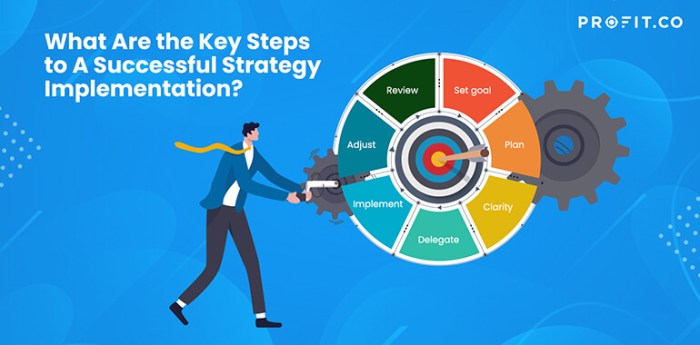
A structured approach is crucial for effective implementation. This framework provides a practical roadmap:
1. Develop a detailed implementation plan
This involves breaking down the overall strategy into smaller, manageable tasks with assigned responsibilities and deadlines.
2. Allocate resources effectively
This includes financial capital, human talent, technology, and other necessary resources. Resource allocation should align directly with the prioritized tasks.
3. Establish clear communication channels
Regular communication keeps everyone informed and aligned, fostering collaboration and accountability.
4. Monitor progress and measure results
Track key performance indicators (KPIs) to assess the effectiveness of the implementation plan and make data-driven adjustments.
5. Adapt and iterate
The business environment is dynamic. Flexibility is key to adjusting the implementation plan as circumstances change.
Comparison of Business Strategy Implementation Methodologies
Different methodologies offer varying approaches to strategy implementation. The choice depends on the project’s nature, organizational culture, and risk tolerance.
| Methodology | Approach | Strengths | Weaknesses |
|---|---|---|---|
| Waterfall | Sequential, linear approach | Simple to understand and manage; well-defined stages | Inflexible; changes are difficult to implement; late detection of errors |
| Agile | Iterative, incremental approach | Flexible; adapts to changing requirements; early detection of errors | Requires experienced teams; can be less predictable in terms of timelines |
| Lean | Focuses on eliminating waste and maximizing value | Efficient; reduces costs; improves quality | Requires a strong commitment to continuous improvement |
| Kanban | Visualizes workflow and limits work in progress | Improves workflow visibility; reduces bottlenecks | Can be challenging to implement in large organizations |
Resource Allocation and Management
Effective resource allocation is paramount to successful business strategy implementation. Without a clear plan for deploying financial, human, and technological resources, even the most well-defined strategy risks failure. This section details the importance of resource allocation, methods for identifying and prioritizing resources, and best practices for managing them throughout the implementation process.Resource allocation ensures that the right resources are available at the right time to support strategic initiatives.
Insufficient resources can lead to delays, compromised quality, and ultimately, the failure to achieve strategic objectives. Conversely, misallocation can lead to wasted resources and inefficient operations. A well-defined resource allocation plan acts as a roadmap, guiding the organization towards its strategic goals and optimizing the use of its assets.
Identifying and Prioritizing Key Resources
Identifying and prioritizing key resources involves a systematic approach to understanding the needs of each strategic initiative. This requires a thorough assessment of the organization’s existing resources and a projection of future requirements. Financial resources are essential for funding projects, acquiring necessary equipment, and covering operational expenses. Human resources represent the skills and expertise needed to execute the strategy.
Technological resources encompass the software, hardware, and infrastructure required to support operations and achieve strategic objectives.Prioritization often employs methods like cost-benefit analysis, which compares the potential return on investment (ROI) of each initiative against its resource requirements. Another approach involves using a weighted scoring system, assigning weights to different criteria (e.g., strategic importance, feasibility, risk) to rank initiatives based on their overall value.
The Pareto principle (80/20 rule) can also guide prioritization, focusing resources on the 20% of activities that yield 80% of the results.
Resource Allocation Plan: Hypothetical Scenario
Let’s consider a hypothetical scenario: a small startup, “EcoClean,” developing a new eco-friendly cleaning product. Their strategy involves launching a targeted marketing campaign, expanding their production capacity, and investing in research and development for new product variations.A possible resource allocation plan might look like this:
| Resource | Marketing Campaign | Production Expansion | R&D |
|---|---|---|---|
| Financial (USD) | $20,000 | $30,000 | $10,000 |
| Human Resources (FTE) | 1 Marketing Manager, 1 Social Media Specialist | 1 Production Supervisor, 2 Production Workers | 1 Chemist, 1 Lab Technician |
| Technological Resources | Social media management tools, website development | New production equipment, inventory management software | Laboratory equipment, research databases |
This plan demonstrates a prioritization towards production expansion, reflecting the importance of meeting anticipated demand. The marketing campaign receives significant funding to generate awareness and sales. R&D receives a smaller allocation, reflecting the startup’s need to focus on immediate revenue generation while still investing in future growth.
Best Practices for Resource Management
Effective resource management throughout the implementation process requires ongoing monitoring, evaluation, and adjustments. Regular progress reviews should be conducted to assess whether resources are being used efficiently and effectively. This involves tracking key performance indicators (KPIs) related to resource utilization and project milestones.
Regular communication and collaboration among teams are vital.
Transparent reporting mechanisms ensure everyone is aware of resource availability and potential constraints. Flexibility is crucial; the allocation plan should be adaptable to unforeseen circumstances and emerging opportunities. Contingency plans should be in place to address potential resource shortages or delays. Finally, a post-implementation review should assess the overall effectiveness of the resource allocation strategy, identifying areas for improvement in future projects.
Communication and Stakeholder Management
Effective communication and robust stakeholder management are paramount to successful business strategy implementation. Without a well-defined communication plan and proactive engagement with all relevant parties, even the most meticulously crafted strategy risks failure. Clear, consistent messaging ensures everyone is aligned on goals, timelines, and responsibilities, fostering collaboration and minimizing misunderstandings. Equally important is anticipating and addressing potential concerns from stakeholders, building trust and buy-in throughout the implementation journey.Successful implementation hinges on transparent and consistent communication.
This involves clearly articulating the strategy’s objectives, outlining the implementation roadmap, and providing regular updates on progress. Failure to maintain open communication channels can lead to confusion, resistance, and ultimately, project derailment. A proactive approach, anticipating potential challenges and addressing them head-on, is far more effective than a reactive one that simply responds to problems as they arise.
The consistent dissemination of information ensures that everyone is informed and involved, promoting a sense of shared ownership and responsibility.
Key Message Definition and Target Audience Identification
Defining key messages and identifying target audiences are crucial first steps in crafting a comprehensive communication plan. Key messages should be concise, memorable, and aligned with the overall strategic goals. For example, if the strategy focuses on improving customer satisfaction, a key message might be “Delivering exceptional customer experiences through enhanced service and product innovation.” Target audiences will vary depending on their role and interest in the implementation.
This might include employees, customers, investors, partners, and regulators. Each audience requires tailored messaging and communication channels to ensure effective delivery.
Communication Channel Selection and Implementation Timeline
Choosing the appropriate communication channels is vital for reaching each target audience effectively. For instance, internal communications might leverage company newsletters, town hall meetings, and intranet updates, while external communications might involve press releases, social media campaigns, and investor presentations. A well-defined timeline ensures that information is delivered at the right time and in the right sequence. For example, a phased approach might start with internal communication to prepare employees, followed by external announcements to customers and investors.
This structured approach minimizes confusion and maximizes the impact of each communication.
Stakeholder Engagement Strategies and Consensus Building
Engaging stakeholders proactively is crucial for building consensus and addressing concerns. This might involve holding regular meetings, conducting surveys, and establishing feedback mechanisms. For example, regular progress reports can keep stakeholders informed, while feedback sessions can address their concerns and incorporate their input. Active listening and addressing concerns directly demonstrate respect and build trust. Strategies to build consensus might include collaborative workshops, facilitated discussions, and the use of conflict resolution techniques.
By fostering a collaborative environment, stakeholders are more likely to support the implementation process and contribute to its success. Addressing concerns early and transparently minimizes the risk of resistance or conflict later in the process.
Monitoring, Evaluation, and Adjustment
Effective monitoring, evaluation, and adjustment are crucial for ensuring a business strategy’s success. Without a robust system in place to track progress, identify shortcomings, and adapt accordingly, even the best-laid plans can falter. This section Artikels methods for establishing such a system, ensuring your strategy remains relevant and effective throughout its implementation.Monitoring progress and measuring implementation effectiveness requires a multifaceted approach.
This involves regularly collecting data, analyzing trends, and comparing actual performance against predetermined targets. This data-driven approach allows for proactive adjustments and prevents minor issues from escalating into major setbacks.
Progress Monitoring Methods
Regular data collection is the cornerstone of effective monitoring. This can be achieved through various methods, including regular project status meetings, automated data dashboards, and periodic surveys of employees and customers. For example, a company launching a new product might track weekly sales figures, customer feedback scores, and marketing campaign performance metrics. Analyzing these data points provides a comprehensive view of the product launch’s success.
By comparing these figures against pre-set targets, the company can quickly identify areas needing attention.
Key Performance Indicators (KPIs)
KPIs are specific, measurable, achievable, relevant, and time-bound (SMART) metrics that reflect the progress toward achieving strategic goals. The selection of KPIs depends on the specific business strategy, but examples include market share, customer acquisition cost, return on investment (ROI), employee satisfaction, and net promoter score (NPS). For instance, a company focused on growth might prioritize revenue growth, market share, and customer acquisition cost as key KPIs.
Conversely, a company focused on efficiency might prioritize operational costs, inventory turnover, and employee productivity. Tracking these KPIs provides a clear picture of progress and highlights areas requiring attention.
Results Evaluation and Improvement Identification
Regular evaluation of results against established KPIs is essential. This involves analyzing the data collected through monitoring, identifying any deviations from targets, and investigating the underlying causes. For instance, if a company’s market share is declining, an evaluation might reveal increased competition, a shift in customer preferences, or a problem with the product itself. This process allows for identifying areas needing improvement and informing subsequent adjustments to the strategy.
Root cause analysis techniques, such as the “5 Whys” method, can be used to delve deeper into the causes of performance gaps.
Strategic Adjustment System
A formal system for making necessary adjustments is critical. This system should define clear procedures for reviewing performance data, identifying areas for improvement, developing and implementing corrective actions, and monitoring the effectiveness of those actions. This might involve regular strategy review meetings, a formal change management process, or a dedicated team responsible for monitoring performance and making adjustments.
For example, if a marketing campaign underperforms, the system might trigger a review of the campaign’s targeting, messaging, or channels. Based on this review, adjustments might be made, such as refining the target audience or changing the advertising channels used. The effectiveness of these adjustments would then be monitored to ensure they are having the desired impact.
Implementing a business strategy is a dynamic process demanding continuous adaptation and refinement. By understanding the key steps – from initial planning and resource allocation to ongoing monitoring and adjustment – businesses can significantly increase their chances of achieving their strategic goals. Remember, consistent communication, proactive risk management, and a commitment to learning from both successes and failures are essential for long-term success.
General Inquiries
What if my initial strategy needs significant changes mid-implementation?
Flexibility is key. Regular monitoring and evaluation allow for course correction. Document the reasons for changes, communicate them clearly to stakeholders, and adjust your resource allocation accordingly.
How do I measure the success of my implementation?
Define clear Key Performance Indicators (KPIs) aligned with your strategic goals. Track these KPIs regularly and compare your actual results against your targets. This data-driven approach will highlight areas of success and areas needing improvement.
What role does leadership play in successful implementation?
Strong leadership is crucial. Leaders must champion the strategy, foster a culture of accountability, provide clear direction, and empower teams to execute effectively. Their commitment and engagement are vital for overcoming challenges and achieving the desired outcomes.
How can I prevent common implementation pitfalls?
Thorough planning, clear communication, proactive risk management, and consistent monitoring are crucial. Avoid scope creep, ensure sufficient resources are allocated, and foster a collaborative environment among stakeholders.