Navigating the complexities of business partnership development requires a strategic approach that balances legal frameworks, financial considerations, and interpersonal dynamics. Success hinges on a shared vision, effective communication, and a robust partnership agreement that clearly defines roles, responsibilities, and profit-sharing mechanisms. This guide explores the multifaceted journey of building and sustaining thriving business partnerships.
From initial concept to long-term growth, we’ll delve into the critical stages of partnership formation, strategic alignment, legal and financial structures, operational efficiency, and ethical considerations. We’ll examine various partnership models, explore conflict resolution strategies, and discuss the crucial role of business coaching in fostering collaboration and maximizing partnership potential. Ultimately, this guide aims to equip aspiring and existing partners with the knowledge and tools to build enduring and profitable ventures.
Defining Business Partnership Development
Business partnership development is the strategic process of identifying, evaluating, and cultivating mutually beneficial relationships with other businesses. It encompasses all activities aimed at building strong, lasting partnerships that enhance the value and capabilities of each participating organization. Effective partnership development leads to increased market share, access to new technologies and resources, and improved overall competitiveness.
Core Components of Successful Business Partnership Development
Successful business partnership development relies on several key elements. A shared vision and clearly defined goals are paramount, ensuring both partners are working towards a common objective. Open communication and trust are fundamental for navigating challenges and maintaining a positive collaborative environment. A well-structured agreement that Artikels responsibilities, profit sharing, and dispute resolution mechanisms is crucial to protect the interests of all parties involved.
Finally, regular evaluation and adaptation are essential to ensure the partnership remains aligned with evolving market conditions and the strategic goals of each partner.
Stages Involved in Forming a Business Partnership
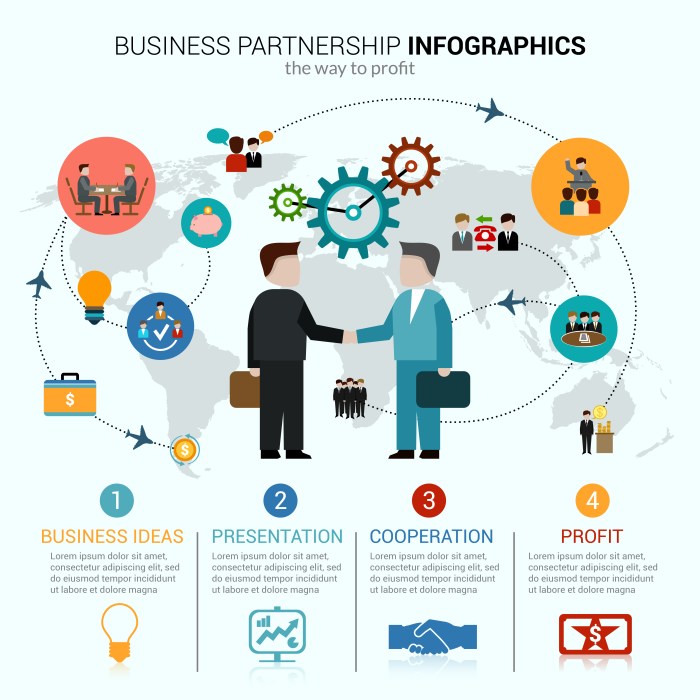
The formation of a successful business partnership typically unfolds in several distinct stages. Initially, there’s the identification and screening of potential partners, followed by a thorough due diligence process to assess compatibility and capabilities. Next, negotiation and agreement creation take place, formalizing the terms of the partnership. Once the agreement is signed, the partnership is launched, requiring ongoing communication, collaboration, and performance monitoring.
Regular reviews and adjustments are essential to maintain a healthy and productive relationship throughout the partnership’s lifespan.
Comparison of Different Partnership Structures
Several legal structures exist for business partnerships, each with its own implications for liability and taxation. A general partnership offers simplicity but exposes partners to unlimited personal liability. A limited partnership provides some protection from liability for limited partners, who have less involvement in management. A Limited Liability Company (LLC) offers the best of both worlds, combining the pass-through taxation of a partnership with the limited liability protection of a corporation.
The optimal structure depends on the specific needs and risk tolerance of the partners involved. For example, a high-risk venture might favor an LLC to shield personal assets, while a low-risk, simple collaboration might benefit from the ease of a general partnership.
Checklist for Evaluating Potential Business Partners
Evaluating potential partners requires a systematic approach. A comprehensive checklist should include assessing the prospective partner’s financial stability, market reputation, and technological capabilities. It’s equally important to evaluate their management team, strategic alignment with your business goals, and their commitment to long-term collaboration. Finally, investigating their legal and regulatory compliance history is crucial to mitigate potential risks.
This due diligence process helps ensure a compatible and reliable partner for a mutually beneficial collaboration.
Strategic Alignment in Business Partnerships
Strategic alignment is the cornerstone of any successful business partnership. Without a shared understanding of objectives and a cohesive approach to achieving them, even the most promising collaborations can falter. This section explores the vital role of shared vision and goals, methods for aligning strategies, examples of successful partnerships, and a framework for resolving inevitable disagreements.
Shared vision and goals are paramount in fostering a productive and enduring business partnership. A clearly defined, mutually agreed-upon vision provides a guiding star, ensuring partners remain focused on common objectives. This shared understanding minimizes misunderstandings, streamlines decision-making, and promotes a collaborative spirit, ultimately leading to greater efficiency and profitability. When partners share a common vision, they are more likely to support each other’s initiatives, anticipate challenges proactively, and celebrate successes collectively.
The lack of a unified vision, conversely, can create internal conflict, inefficient resource allocation, and ultimately, partnership failure.
Methods for Aligning Business Strategies
Aligning business strategies requires a structured approach. This involves a thorough assessment of each partner’s individual strengths, weaknesses, opportunities, and threats (SWOT analysis), followed by a collaborative effort to identify synergies and areas of potential conflict. Regular communication, transparent information sharing, and the establishment of clear roles and responsibilities are crucial. Formal agreements, outlining strategic objectives, performance metrics, and decision-making processes, provide a solid foundation for a long-term partnership.
Furthermore, a joint strategic planning process, where partners actively participate in defining the overall strategy and individual contributions, fosters a sense of ownership and commitment. Finally, incorporating mechanisms for regular review and adaptation of the strategy allows the partnership to remain agile and responsive to changing market conditions.
Examples of Successful Strategic Alliances
Numerous successful strategic alliances demonstrate the power of strategic alignment. For example, the partnership between Apple and IBM, combining Apple’s consumer electronics expertise with IBM’s enterprise software capabilities, created a powerful synergy, leading to the development of innovative mobile business solutions. Similarly, the alliance between Starbucks and Barnes & Noble, combining the appeal of coffee and books, created a successful co-branding strategy that benefited both partners.
These successful alliances highlight the importance of complementary strengths, clear roles, and a shared commitment to achieving common goals. The key contributing factors in these successes include a thorough understanding of each partner’s capabilities, a clear definition of roles and responsibilities, and consistent communication and collaboration.
Framework for Resolving Strategic Disagreements
Disagreements are inevitable in any partnership. Establishing a proactive framework for addressing these conflicts is crucial. This framework should include clearly defined communication protocols, emphasizing open dialogue and active listening. A structured process for conflict resolution, possibly involving mediation or arbitration, should be established. Regular performance reviews, focused on objective metrics, can help identify and address potential sources of conflict early on.
Furthermore, a pre-agreed dispute resolution mechanism, such as binding arbitration, can help avoid costly and time-consuming legal battles. Ultimately, a commitment to mutual respect, compromise, and a focus on the overall partnership goals is essential for navigating disagreements effectively.
Legal and Financial Aspects of Business Partnerships
Successfully navigating the legal and financial landscape is crucial for any business partnership to thrive. A well-defined structure, coupled with a robust partnership agreement and a clear financial strategy, can significantly reduce future conflicts and ensure the long-term viability of the venture. Ignoring these aspects can lead to costly disputes and even the dissolution of the partnership.
Key Legal Considerations When Establishing a Business Partnership
Choosing the right legal structure is paramount. This decision impacts liability, taxation, and administrative burdens. Factors to consider include the number of partners, the level of liability each partner is willing to accept, and the desired level of control. Careful consideration of these factors will guide the selection of the most appropriate structure for the specific business needs.
Seeking legal counsel is strongly recommended to ensure compliance with all relevant regulations and to tailor the structure to the partnership’s unique circumstances.
Drafting a Comprehensive Partnership Agreement
A comprehensive partnership agreement serves as the foundational document governing the relationship between partners. It should clearly Artikel each partner’s contributions (capital, expertise, etc.), responsibilities, profit and loss sharing ratios, decision-making processes, dispute resolution mechanisms, and procedures for admitting or withdrawing partners. The agreement should also address issues such as intellectual property rights, confidentiality, and the process for dissolving the partnership.
A well-drafted agreement minimizes ambiguity and protects the interests of all partners. It’s advisable to have the agreement reviewed by legal professionals to ensure it is legally sound and comprehensive.
Methods for Managing Partnership Finances and Distributions
Effective financial management is essential for the success of any partnership. This involves establishing clear accounting procedures, regular financial reporting, and a transparent system for distributing profits and losses. Methods for managing finances can range from simple bookkeeping systems to sophisticated accounting software, depending on the size and complexity of the partnership. Regular financial reviews and audits can help identify potential problems and ensure the partnership remains financially healthy.
A clearly defined process for distributing profits and losses, based on the partnership agreement, prevents disputes and ensures fairness among partners.
Tax Implications for Various Partnership Structures
The tax implications for business partnerships vary significantly depending on the chosen legal structure. Understanding these implications is critical for effective tax planning and compliance. Different structures have different rules regarding the allocation of income, deductions, and tax liabilities among partners.
| Aspect | General Partnership | Limited Partnership | LLC (Limited Liability Company) |
|---|---|---|---|
| Liability | Partners have unlimited personal liability | General partners have unlimited liability; limited partners have limited liability | Members have limited liability |
| Taxation | Pass-through taxation; profits and losses are reported on partners’ individual tax returns | Pass-through taxation; profits and losses are reported on partners’ individual tax returns | Can be taxed as a pass-through entity (like a partnership) or as a corporation, depending on election |
| Management | All partners typically participate in management | General partners manage the business; limited partners typically have limited or no management rights | Members can participate in management, depending on the operating agreement |
| Formation | Relatively simple to form; may require a partnership agreement | Requires a more formal partnership agreement | Requires filing articles of organization and an operating agreement |
Operational Efficiency and Collaboration
Effective collaboration is the cornerstone of a successful business partnership. Streamlining operations and fostering a positive working relationship between partners directly impacts profitability and longevity. This section details strategies for achieving optimal operational efficiency and harmonious collaboration.
Effective Communication Strategies for Business Partners
Open and consistent communication is paramount. Partners should establish clear communication channels, such as regular meetings (both formal and informal), instant messaging platforms, and shared project management tools. The frequency and format of communication should be agreed upon early and adapted as needed. Active listening, clear articulation of ideas, and providing constructive feedback are essential components of effective communication.
Regularly scheduled check-ins, even brief ones, can prevent misunderstandings and maintain momentum. Utilizing a centralized communication system ensures all partners are on the same page and reduces the risk of missed information.
Conflict Resolution and Dispute Management
Disagreements are inevitable in any partnership. A pre-agreed dispute resolution process is crucial. This might involve a structured approach, such as mediation by a neutral third party, arbitration, or even litigation as a last resort. However, before escalating, partners should prioritize open dialogue and attempt to resolve conflicts through direct communication. Establishing a clear framework for addressing disagreements, including steps to follow and potential outcomes, helps maintain a professional and productive relationship.
For example, a simple process might involve a private conversation between the disagreeing parties, followed by a joint discussion with all partners if the issue remains unresolved.
Establishing Clear Roles and Responsibilities
Clearly defined roles and responsibilities prevent duplication of effort and potential conflicts. A detailed partnership agreement should Artikel each partner’s specific contributions, responsibilities, and decision-making authority. This should encompass operational tasks, strategic planning, and financial management. A well-defined structure ensures accountability and allows each partner to focus their expertise effectively. For instance, one partner might manage marketing and sales while the other handles finance and operations.
This clarity avoids confusion and promotes efficiency.
Workflow for Collaborative Decision-Making
A structured approach to decision-making ensures fairness and transparency. This could involve a weighted voting system based on partnership shares, a consensus-based approach requiring unanimous agreement, or a combination of both. Regardless of the chosen method, the process should be documented and understood by all partners. For instance, a system might involve presenting proposals, allowing time for discussion and feedback, and then voting on the final decision.
Transparency and documentation at every step are key to building trust and avoiding misunderstandings. A clearly defined decision-making process promotes a fair and efficient approach to partnership governance.
Business Development within Partnerships
Successful business development is the lifeblood of any thriving partnership. It fuels growth, expands market reach, and ultimately determines the overall success and longevity of the collaborative venture. By strategically aligning business development activities with the partnership’s core objectives, partners can unlock significant synergistic opportunities and maximize their collective potential.Business development activities directly contribute to partnership success by generating new revenue streams, increasing market share, and enhancing brand recognition.
These activities create opportunities for cross-selling and upselling products or services, leveraging each partner’s existing customer base and expertise to reach a wider audience. Furthermore, effective business development fosters innovation, allowing partners to combine their strengths and resources to develop new products, services, or solutions that address unmet market needs. This collaborative approach to innovation leads to a competitive advantage and strengthens the overall value proposition of the partnership.
Strategies for Identifying and Pursuing New Business Opportunities
Identifying and pursuing new business opportunities requires a proactive and systematic approach. This involves a thorough market analysis to pinpoint areas of unmet demand, identifying potential target markets, and assessing the competitive landscape. A robust strategy also involves leveraging the combined networks and expertise of the partners to discover synergistic opportunities. This might include exploring new geographic markets, developing complementary products or services, or targeting new customer segments.
- Market Research and Analysis: Conducting thorough market research to identify trends, unmet needs, and potential opportunities within existing and new markets.
- Competitive Analysis: Assessing the competitive landscape to understand the strengths and weaknesses of competitors and identify potential areas for differentiation.
- Synergistic Opportunity Identification: Leveraging the combined strengths, resources, and networks of the partners to uncover synergistic opportunities for growth and expansion.
- Target Market Selection: Defining specific target markets based on demographic, geographic, and psychographic factors, focusing on those most receptive to the partnership’s offerings.
- Opportunity Prioritization: Evaluating and prioritizing potential opportunities based on factors such as market size, growth potential, and alignment with partnership objectives.
Effective Marketing and Sales Strategies for Partnerships
Effective marketing and sales strategies for partnerships hinge on leveraging the combined strengths and resources of each partner. This includes creating a unified brand message that resonates with the target audience, developing joint marketing campaigns, and establishing clear roles and responsibilities for sales and marketing activities. Utilizing cross-promotion techniques, such as email marketing campaigns and social media engagement, can significantly expand reach and amplify the partnership’s message.
Furthermore, co-branded materials and joint events further enhance brand visibility and strengthen the partnership’s market presence.
- Unified Branding and Messaging: Creating a consistent brand message and visual identity across all marketing and sales materials.
- Joint Marketing Campaigns: Developing and implementing collaborative marketing campaigns that leverage the strengths of each partner.
- Cross-Promotion Strategies: Utilizing cross-promotion techniques, such as email marketing and social media, to expand reach and amplify the partnership’s message.
- Co-branded Materials: Developing co-branded materials, such as brochures, website content, and presentations, to reinforce the partnership’s identity.
- Joint Events and Trade Shows: Participating in joint events and trade shows to increase brand visibility and generate leads.
Measuring the Success of Business Development Initiatives
Measuring the success of business development initiatives requires establishing clear Key Performance Indicators (KPIs) aligned with the partnership’s overall goals. These KPIs should track metrics such as revenue generation, market share growth, lead generation, customer acquisition cost, and brand awareness. Regular monitoring and analysis of these KPIs provide insights into the effectiveness of business development activities and allow for necessary adjustments to the strategy.
For example, tracking the number of new customers acquired through joint marketing campaigns provides a direct measure of the success of those campaigns. Similarly, monitoring website traffic and social media engagement can provide insights into brand awareness and reach.
Effective measurement requires a combination of quantitative and qualitative data to provide a holistic view of the impact of business development initiatives.
Business Ethics in Partnerships
Building a successful business partnership requires more than just a shared vision and complementary skills; it necessitates a strong ethical foundation. A commitment to ethical conduct fosters trust, transparency, and long-term stability, crucial elements for navigating the inevitable challenges inherent in any collaborative venture. Ignoring ethical considerations can lead to irreparable damage to the partnership and its reputation.Ethical considerations are paramount in ensuring the longevity and success of a business partnership.
Unethical behavior, even seemingly minor infractions, can erode trust among partners, damage relationships with clients and stakeholders, and ultimately jeopardize the financial viability of the business. Maintaining high ethical standards is not merely a matter of compliance; it’s a strategic imperative for building a sustainable and thriving partnership.
Implications of Unethical Behavior
Unethical actions, such as misappropriation of funds, breach of confidentiality, or unfair distribution of profits, can have severe repercussions. These actions can lead to legal disputes, reputational damage, loss of investor confidence, and ultimately, the dissolution of the partnership. The resulting financial losses and emotional toll can be devastating for all involved. For example, a partner embezzling funds could trigger a cascade of consequences, including legal fees, potential criminal charges, and the complete breakdown of trust between partners, ultimately leading to the failure of the business.
Ethical Dilemmas and Potential Solutions
Business partnerships frequently encounter ethical dilemmas. One common scenario involves conflicts of interest. For instance, a partner might have a personal business that directly competes with the partnership, creating a situation where their loyalty is divided. A solution could involve transparent disclosure of the conflict and establishing clear boundaries to ensure the partnership’s interests are prioritized. Another common dilemma is the fair distribution of profits and responsibilities.
If one partner consistently contributes more effort or expertise, disputes over compensation can arise. A solution involves establishing a clear, well-defined profit-sharing agreement from the outset, based on a fair and transparent assessment of each partner’s contributions. This might involve a combination of fixed percentages, performance-based bonuses, or other agreed-upon metrics.
A Hypothetical Code of Ethics
This code Artikels key principles and guidelines for a hypothetical business partnership:
Principle 1: Transparency and Open Communication: All partners will maintain open and honest communication, promptly addressing any concerns or disagreements.
Principle 2: Fair and Equitable Profit Sharing: Profit distribution will be based on a pre-agreed formula, reflecting the relative contributions and responsibilities of each partner. Regular reviews of this formula will be conducted to ensure ongoing fairness.
Principle 3: Conflict of Interest Management: Partners will disclose any potential conflicts of interest and agree on measures to mitigate any adverse impact on the partnership.
Principle 4: Confidentiality and Data Security: All confidential information related to the partnership will be protected and handled responsibly. Partners will adhere to strict data security protocols.
Principle 5: Respectful and Professional Conduct: Partners will treat each other, employees, clients, and stakeholders with respect and professionalism at all times.
Principle 6: Compliance with Laws and Regulations: The partnership will operate in full compliance with all applicable laws and regulations.
Principle 7: Commitment to Sustainability: The partnership will operate in a socially and environmentally responsible manner.
Principle 8: Accountability and Responsibility: Partners will be held accountable for their actions and decisions, taking ownership of their responsibilities within the partnership.
Business Coaching and Partnerships
Business coaching offers a powerful tool for enhancing the performance and longevity of business partnerships. By providing an objective perspective and specialized guidance, a coach can help partners navigate challenges, improve communication, and unlock their collective potential, leading to increased profitability and stronger relationships. The benefits extend beyond individual partner development, fostering a more collaborative and effective partnership overall.Business coaching significantly improves partnership performance by addressing critical areas often neglected during the day-to-day operations.
A coach acts as a facilitator, helping partners articulate their individual goals and align them with the overarching partnership objectives. This process clarifies roles, responsibilities, and expectations, minimizing misunderstandings and conflict. Furthermore, coaching helps partners develop essential skills such as active listening, conflict resolution, and strategic decision-making, directly impacting their ability to work together efficiently and productively.
The Role of a Business Coach in Facilitating Communication and Collaboration
The business coach acts as a neutral third party, creating a safe space for open and honest communication. They employ active listening techniques to understand each partner’s perspective, identify communication breakdowns, and help them articulate their needs effectively. Coaches facilitate collaborative problem-solving by guiding partners through structured discussions, encouraging them to explore different viewpoints, and helping them reach mutually agreeable solutions.
This process builds trust and mutual respect, strengthening the foundation of the partnership. They may also introduce tools and techniques for improved communication, such as regular check-ins, structured meeting agendas, and conflict resolution strategies. For example, a coach might help partners implement a system of regular feedback sessions using a structured feedback form to ensure consistent and constructive communication.
Coaching Techniques to Improve Partnership Dynamics
Several coaching techniques can be employed to enhance partnership dynamics. One effective technique is the use of appreciative inquiry, which focuses on identifying and building upon the strengths and successes of the partnership rather than dwelling on weaknesses. This approach fosters a positive and collaborative environment. Another valuable technique is the application of conflict resolution models, such as the Thomas-Kilmann Conflict Mode Instrument (TKI), which helps partners understand their conflict styles and develop strategies for managing disagreements constructively.
Finally, goal-setting and accountability frameworks, such as OKRs (Objectives and Key Results), can be implemented to provide clarity, direction, and a mechanism for tracking progress towards shared objectives. For instance, a coach might guide partners through a process of defining specific, measurable, achievable, relevant, and time-bound (SMART) goals for the partnership.
Evaluating the Effectiveness of Business Coaching
Evaluating the effectiveness of business coaching requires a multi-faceted approach. Quantitative measures, such as increased revenue, improved profitability, and enhanced market share, can provide evidence of the coaching’s impact on the partnership’s financial performance. Qualitative data, obtained through partner feedback surveys, observations of improved communication and collaboration, and assessments of conflict resolution capabilities, offer a more nuanced understanding of the coaching’s influence on the partnership dynamics.
Regular progress reviews, conducted by the coach and the partners, provide opportunities for ongoing assessment and adjustments to the coaching plan. For example, a post-coaching survey could ask partners to rate their satisfaction with the coaching process, their perception of improved communication, and their overall assessment of the partnership’s performance. A comparison of key performance indicators (KPIs) before and after the coaching intervention can also provide valuable insights into its effectiveness.
Business Loans and Partnerships
Securing funding is a crucial step for any business partnership, impacting growth and stability. Understanding the process of obtaining business loans, the associated requirements, and the various loan options available is essential for successful financial management. This section will Artikel the key aspects of obtaining business loans as a partnership.
The process of securing a business loan for a partnership involves several key steps, beginning with a thorough assessment of your business’s financial health and future projections. This includes creating a comprehensive business plan, detailing the partnership’s structure, financial history, and future goals. A strong business plan demonstrates your understanding of the market, your target audience, and your ability to manage finances effectively, significantly increasing your chances of loan approval.
Loan Application Requirements and Criteria
Lenders typically evaluate several factors when considering a loan application from a partnership. These include the creditworthiness of each partner, the partnership’s financial history (revenue, expenses, profit margins), the business plan’s viability, and the proposed use of the loan funds. Strong collateral, such as real estate or equipment, can also strengthen the application. A detailed financial statement, including profit and loss statements, balance sheets, and cash flow statements, is essential to demonstrate the partnership’s financial stability and repayment capacity.
Lenders will also scrutinize the partnership agreement to understand the legal structure and responsibilities of each partner.
Types of Business Loans Available to Partnerships
Several types of business loans cater to the specific needs of partnerships. These include term loans, lines of credit, SBA loans (Small Business Administration loans), and equipment financing. Term loans provide a fixed amount of money over a set period, with regular repayments. Lines of credit offer flexible access to funds up to a pre-approved limit. SBA loans offer government-backed financing, often with more favorable terms than conventional loans.
Equipment financing allows businesses to purchase equipment using the equipment itself as collateral. The best option depends on the partnership’s specific financial needs and risk tolerance.
Loan Terms, Interest Rates, and Repayment Schedules
The terms of a business loan, including interest rates and repayment schedules, vary significantly depending on the lender, the type of loan, and the partnership’s creditworthiness. Understanding these terms is crucial for making informed financial decisions. Generally, loans with longer repayment terms have lower monthly payments but higher overall interest costs. Conversely, shorter-term loans have higher monthly payments but lower overall interest costs.
Interest rates are influenced by several factors, including prevailing market interest rates, the lender’s risk assessment, and the partnership’s credit score.
| Loan Type | Interest Rate | Repayment Terms | Eligibility Criteria |
|---|---|---|---|
| Term Loan | Variable, typically 5-15% | 1-10 years | Good credit history, strong financial statements, viable business plan |
| Line of Credit | Variable, typically 8-18% | Revolving credit, typically 1-3 years | Good credit history, strong cash flow, established business |
| SBA Loan | Variable, typically lower than conventional loans | 10-25 years | Meets SBA eligibility requirements, strong business plan, good credit history |
| Equipment Financing | Variable, typically 7-15% | 3-7 years | Good credit history, the value of the equipment as collateral |
Business Models and Partnerships
The choice of business model significantly influences the structure and success of a partnership. Understanding how different models impact operational aspects, legal considerations, and overall profitability is crucial for effective partnership development. This section explores various business models commonly used in partnerships, highlighting their advantages and disadvantages, and illustrating their application through successful examples.
Impact of Business Models on Partnership Structures
Different business models inherently dictate the level of control, risk-sharing, and profit distribution within a partnership. For instance, a franchise model necessitates a clearly defined operational structure and agreement regarding royalties and brand adherence, while a joint venture necessitates a more collaborative approach to decision-making and resource allocation. The legal structure chosen (e.g., general partnership, limited liability partnership) also interacts with the business model to shape the overall partnership framework.
A well-defined business model provides a roadmap for the partnership, guiding its operational strategy and mitigating potential conflicts.
Advantages and Disadvantages of Business Models for Partnerships
The optimal business model depends on several factors, including the partners’ expertise, risk tolerance, and long-term goals. Each model presents unique advantages and disadvantages that must be carefully considered. For example, a sole proprietorship, while simple to set up, exposes partners to unlimited personal liability. Conversely, a limited liability company (LLC) offers liability protection but may involve more complex administrative requirements.
A thorough understanding of these trade-offs is essential for choosing the most appropriate model.
Examples of Successful Partnerships Using Diverse Business Models
Numerous successful partnerships leverage various business models. Consider Starbucks and PepsiCo’s joint venture to distribute Frappuccino beverages. This strategic partnership combines Starbucks’ brand recognition and coffee expertise with PepsiCo’s extensive distribution network and marketing capabilities. Another example is the franchise model utilized by McDonald’s, where individual franchisees operate restaurants under a globally recognized brand, benefiting from established systems and brand equity while maintaining a degree of operational autonomy.
These examples demonstrate how the right business model can significantly contribute to partnership success.
Comparative Analysis of Three Business Models Suitable for Partnerships
A comparative analysis of three distinct business models—sole proprietorship, partnership, and LLC—reveals their suitability for various partnership contexts.
Below is a comparative analysis of three distinct business models suitable for partnerships:
| Business Model | Pros | Cons |
|---|---|---|
| Sole Proprietorship |
|
|
| Partnership (General Partnership) |
|
|
| Limited Liability Company (LLC) |
|
|
Business Strategy and Partnerships
Developing a robust business strategy is paramount for any partnership, ensuring alignment, growth, and longevity. A well-defined strategy provides a roadmap, guiding partners through challenges and opportunities, maximizing their collective strengths and minimizing potential conflicts. This involves a thorough understanding of the market, the competitive landscape, and the unique value proposition the partnership offers.A comprehensive business strategy for a partnership requires a synergistic blend of individual partner expertise and a shared vision.
It should not simply be a merging of individual business plans, but rather a newly crafted strategy leveraging the unique capabilities and resources of each partner. This process necessitates open communication, mutual respect, and a commitment to collaborative decision-making.
Market Analysis and Competitive Advantage
Understanding the target market is foundational. This involves detailed market research to identify customer needs, preferences, and buying behaviors. Competitive analysis is equally crucial, identifying direct and indirect competitors, their strengths and weaknesses, and their market share. By understanding the competitive landscape, the partnership can define its unique selling proposition (USP), highlighting what differentiates it from competitors and attracts customers.
For instance, a partnership between a software developer and a marketing agency might leverage the developer’s technical expertise and the agency’s marketing prowess to offer a superior, more integrated solution than competitors offering these services separately. This integrated offering becomes their competitive advantage.
Effective Strategic Planning Processes for Partnerships
Effective strategic planning for partnerships often follows a structured approach. This typically involves defining the partnership’s mission, vision, and values; conducting a SWOT analysis (Strengths, Weaknesses, Opportunities, Threats); setting specific, measurable, achievable, relevant, and time-bound (SMART) goals; developing action plans with clear responsibilities and timelines; and establishing key performance indicators (KPIs) to track progress and measure success. Regular review and adaptation of the strategy are also vital to respond to changing market conditions and emerging opportunities.
A collaborative approach, using tools like workshops and shared documents, ensures transparency and buy-in from all partners.
Strategic Plan for a Hypothetical Business Partnership
Let’s consider a hypothetical partnership between a local bakery (“Sweet Success”) and a coffee roaster (“Brewtiful Beans”). Their combined goal is to open a café offering high-quality baked goods and specialty coffee.
Key Objectives:
- Secure a suitable location within six months.
- Develop a comprehensive menu and pricing strategy within three months.
- Establish a strong brand identity and marketing plan within two months.
- Achieve profitability within one year of opening.
Action Steps:
- Sweet Success: Develop recipes and production processes for café-specific items.
- Brewtiful Beans: Secure coffee bean supply and develop signature coffee blends.
- Jointly: Conduct market research to identify optimal location and target customer base. Secure necessary permits and licenses.
- Jointly: Design café layout and develop marketing materials (website, social media, etc.).
- Jointly: Recruit and train staff.
This plan Artikels clear objectives and actionable steps, allocating responsibilities and establishing timelines. Regular review meetings will ensure the partnership stays on track and adapts to any unforeseen challenges or opportunities. KPIs such as customer satisfaction scores, sales figures, and operational efficiency will be tracked to monitor progress and make necessary adjustments.
Business Travel and Partnerships
Business travel plays a crucial role in cultivating and strengthening business partnerships. It provides opportunities for face-to-face interaction, relationship building, and collaborative problem-solving that are often difficult to replicate through virtual communication. Strategic business travel can significantly impact the success and longevity of partnerships.Effective business travel contributes directly to partnership success by fostering stronger relationships and improving communication.
In-person meetings allow for more nuanced communication, better understanding of nonverbal cues, and the development of trust and rapport, all vital components of a successful partnership.
Effective Travel Planning and Management
Effective planning and management of business travel are paramount to maximizing its benefits while minimizing potential disruptions and costs. A well-structured travel plan considers factors such as flight schedules, accommodation, meeting agendas, and potential unforeseen circumstances. This includes pre-booking flights and accommodations to secure favorable rates, coordinating schedules with partners to optimize meeting times, and having contingency plans for travel delays or cancellations.
Proactive management ensures that travel time is used efficiently and productively.
Examples of Business Travel’s Contribution to Partnership Success
Several scenarios illustrate how business travel strengthens partnerships. For example, a joint venture between a software company and a marketing firm might involve travel to each other’s offices for collaborative workshops and strategic planning sessions. This allows for in-depth discussions, brainstorming, and the development of a shared understanding of goals and processes. Similarly, a manufacturing company partnering with a supplier might send representatives to the supplier’s facilities for quality control inspections and collaborative problem-solving related to production challenges.
These in-person interactions build trust and foster a stronger working relationship. Another example would be a technology firm collaborating with a research institution; on-site visits to the institution’s labs allow for direct observation of research progress and facilitate real-time discussions regarding the development of new technologies.
Costs Associated with Business Travel and Cost Reduction Methods
Business travel inherently involves costs including airfare, accommodation, ground transportation, meals, and incidental expenses. These costs can be substantial, especially for partnerships involving frequent travel across geographical distances. However, there are several strategies to mitigate these expenses. Negotiating favorable rates with airlines and hotels through corporate travel programs can significantly reduce costs. Utilizing video conferencing for some meetings, prioritizing cost-effective travel options (e.g., budget airlines, shared accommodations), and optimizing travel itineraries to minimize time spent traveling can also help.
Implementing a robust travel expense management system ensures accountability and minimizes unnecessary spending. Careful consideration of the return on investment (ROI) of each trip helps justify the expense and ensures that travel is strategically planned and only undertaken when necessary.
Developing a successful business partnership is a dynamic process that demands careful planning, open communication, and a commitment to shared goals. By understanding the legal, financial, and operational aspects, and by proactively addressing potential conflicts, partners can create a strong foundation for growth and mutual success. This guide has provided a framework for navigating the complexities of partnership development, empowering you to build a thriving and enduring business relationship.
Answers to Common Questions
What are the common reasons for business partnership failures?
Common reasons include poor communication, lack of clearly defined roles, unresolved conflicts, unequal contribution, and insufficient planning.
How can I find a suitable business partner?
Network actively, leverage professional connections, and carefully vet potential partners through due diligence and background checks. Look for complementary skills and a shared vision.
What is the best legal structure for a business partnership?
The optimal legal structure depends on factors like liability concerns, tax implications, and management preferences. Consulting with legal and financial professionals is crucial for making an informed decision.
How important is a written partnership agreement?
A comprehensive written agreement is paramount. It prevents misunderstandings, clarifies responsibilities, and protects the interests of all partners.
How can we prevent conflicts in a business partnership?
Establish clear communication channels, proactively address disagreements, implement conflict resolution strategies, and consider mediation or arbitration if needed.