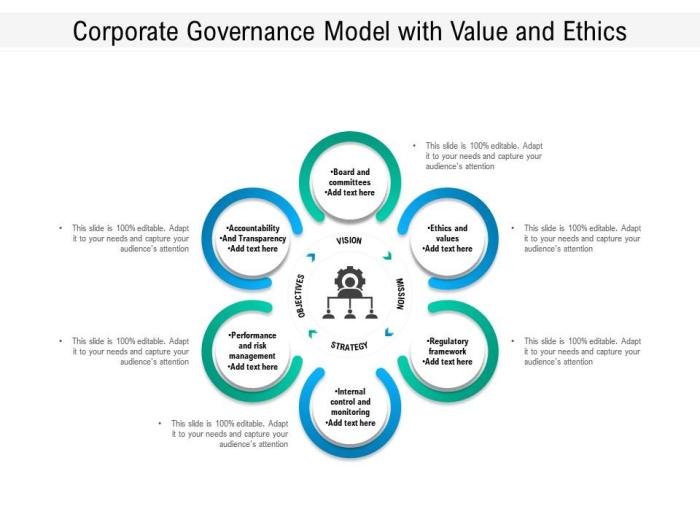
Corporate governance and ethics are cornerstones of responsible business practice, shaping not only a company’s internal operations but also its external relationships and long-term sustainability. This exploration delves into the core principles, examining how strong ethical frameworks, effective leadership, and robust risk management strategies intertwine to foster trust, enhance reputation, and drive sustainable growth. We’ll explore various models of governance, ethical dilemmas, and the crucial role of stakeholder engagement in navigating complex ethical landscapes.
From defining the fundamental principles of corporate governance and outlining best practices to analyzing the impact of leadership styles and exploring the intersection of ethics with business development, this guide provides a holistic understanding of the subject. We’ll examine real-world examples of both ethical triumphs and failures, highlighting the critical importance of integrating ethical considerations into every aspect of business strategy.
Defining Corporate Governance and Ethics
Corporate governance and ethics are intertwined concepts crucial for the long-term success and sustainability of any organization. Effective governance structures and a robust ethical framework foster trust, transparency, and accountability, ultimately leading to increased stakeholder value and a positive societal impact. This section will delve into the core principles of each, highlighting their interconnectedness and exploring various models and challenges.
Core Principles of Corporate Governance
Corporate governance encompasses the systems and processes by which companies are directed and controlled. Its core principles aim to ensure that organizations are run in the best interests of all stakeholders, including shareholders, employees, customers, suppliers, and the wider community. These principles typically include accountability, fairness, transparency, responsibility, and the rule of law. Accountability involves holding individuals and entities responsible for their actions and decisions.
Fairness ensures equitable treatment of all stakeholders. Transparency demands open communication and disclosure of relevant information. Responsibility emphasizes the duty of care owed to stakeholders. Finally, adherence to the rule of law ensures compliance with all applicable laws and regulations. The implementation of these principles varies across different corporate structures and jurisdictions.
Key Elements of a Strong Ethical Framework
A strong ethical framework within a corporation goes beyond mere compliance with laws and regulations. It involves embedding ethical values and principles into the company culture, decision-making processes, and daily operations. Key elements include a clearly defined code of conduct, comprehensive ethics training programs for all employees, effective mechanisms for reporting and investigating ethical violations (whistleblowing programs), a commitment to ethical leadership from the top down, and regular ethical audits to assess compliance and identify areas for improvement.
Furthermore, a strong ethical framework fosters a culture of integrity and responsibility, encouraging employees to make ethical choices even in challenging situations.
Comparison of Corporate Governance Models
Different models of corporate governance exist globally, each with its own strengths and weaknesses. The Anglo-American model, prevalent in the United States and the United Kingdom, emphasizes shareholder primacy, focusing on maximizing shareholder value. In contrast, the stakeholder model, common in continental Europe and parts of Asia, prioritizes the interests of all stakeholders, including employees, customers, and the community.
The German two-tier board system, for instance, features a supervisory board overseeing the management board, providing a balance of power and enhancing stakeholder representation. These contrasting approaches reflect differing cultural values and legal frameworks.
Examples of Ethical Dilemmas Faced by Corporations
Corporations frequently encounter ethical dilemmas that require careful consideration and ethical decision-making. Examples include issues related to environmental sustainability (e.g., pollution, resource depletion), labor practices (e.g., fair wages, working conditions), product safety (e.g., defective products, misleading advertising), data privacy (e.g., misuse of customer data), and bribery and corruption. Each of these dilemmas presents a complex interplay of competing interests and requires a careful balancing act between profitability, ethical considerations, and legal compliance.
For instance, a company might face a dilemma between maximizing profits by cutting corners on safety measures and ensuring the safety of its consumers.
Best Practices in Corporate Governance and Ethics
| Area | Best Practice | Benefit | Example |
|---|---|---|---|
| Board Composition | Diverse and independent board members with relevant expertise | Improved decision-making, enhanced oversight | Including members with backgrounds in finance, law, and technology |
| Executive Compensation | Transparent and performance-based compensation structures | Alignment of executive interests with shareholder interests | Linking bonuses to long-term performance goals |
| Risk Management | Robust risk assessment and mitigation processes | Reduced exposure to financial and reputational risks | Regular risk assessments and development of contingency plans |
| Ethical Culture | Clear code of conduct, ethics training, and reporting mechanisms | Increased ethical awareness and behavior | Anonymous reporting hotlines and regular ethics training |
The Role of Leadership in Promoting Ethical Conduct
Ethical conduct within a corporation isn’t simply a matter of compliance; it’s a reflection of the values and priorities established by its leadership. Leaders set the tone, shaping the organizational culture and influencing the ethical decision-making processes of every employee. Their actions, or inactions, significantly impact the company’s reputation, financial performance, and overall success.Leadership’s responsibility in fostering ethical behavior is paramount.
It extends beyond simply adhering to legal regulations; it necessitates proactively cultivating a culture of integrity, transparency, and accountability. This requires a conscious effort to define and communicate ethical standards, provide ethical training, and consistently enforce ethical conduct throughout the organization. The absence of strong ethical leadership often results in a culture of permissiveness, where unethical behavior may flourish unchecked.
Impact of Leadership Styles on Corporate Ethics
Different leadership styles demonstrably affect the ethical climate of an organization. Transformational leaders, who inspire and motivate their teams through shared vision and values, are more likely to foster ethical behavior. Their emphasis on purpose and intrinsic motivation encourages employees to act ethically, even in the absence of explicit rules. Conversely, autocratic or laissez-faire leadership styles can create environments where ethical considerations are minimized, leading to a higher risk of unethical conduct.
A transactional leadership approach, focusing solely on rewards and punishments, may incentivize compliance but not necessarily genuine ethical commitment.
Strategies for Leaders to Promote Ethical Decision-Making
Leaders can implement several strategies to promote ethical decision-making. These include establishing clear ethical guidelines and codes of conduct, providing regular ethics training, creating mechanisms for reporting unethical behavior (whistleblowing), and ensuring that ethical considerations are integrated into all business decisions. Furthermore, leaders should lead by example, consistently demonstrating ethical behavior in their own actions and interactions. Regular communication reinforcing the importance of ethics and providing opportunities for open dialogue are also crucial.
Finally, implementing robust internal controls and auditing processes can help to detect and prevent unethical behavior.
Designing a Training Program for Leaders on Ethical Leadership
A comprehensive training program for leaders on ethical leadership should incorporate various learning methods. It should begin with defining the organization’s ethical values and principles, followed by exploring relevant ethical dilemmas and case studies. Interactive workshops focusing on ethical decision-making frameworks, such as the ethical decision-making model or the four-way test, would enhance practical application. Role-playing scenarios can help leaders practice responding to ethical challenges.
The program should also cover legal and regulatory requirements, whistleblower protection policies, and the importance of fostering a culture of ethical conduct. Finally, the program should incorporate ongoing reinforcement and updates to address evolving ethical challenges.
Examples of Companies with Strong Ethical Leadership
Companies like Patagonia, known for its commitment to environmental sustainability and fair labor practices, exemplify strong ethical leadership. Their commitment extends beyond profit maximization, demonstrating a dedication to social and environmental responsibility. Similarly, Johnson & Johnson’s Credo, a statement of ethical principles guiding all aspects of their business, has served as a cornerstone of their ethical reputation for decades.
These companies demonstrate that strong ethical leadership is not only possible but can also be a significant source of competitive advantage. Their actions often result in enhanced brand reputation, increased customer loyalty, and improved employee morale and engagement.
Corporate Social Responsibility and Stakeholder Engagement
Corporate Social Responsibility (CSR) and effective stakeholder engagement are crucial elements of modern corporate governance. A company’s success is increasingly tied not only to its financial performance but also to its social and environmental impact, and how it interacts with all those affected by its operations. This section will explore the concept of CSR, identify key stakeholders, detail effective engagement methods, and illustrate how a well-executed stakeholder engagement strategy can enhance a company’s reputation.
Defining Corporate Social Responsibility
Corporate Social Responsibility (CSR) refers to a company’s commitment to operating ethically and sustainably, considering the interests of all stakeholders – not just shareholders – in its decision-making processes. This involves going beyond simply complying with legal requirements and actively contributing to the well-being of society and the environment. CSR initiatives can encompass a wide range of activities, from reducing carbon emissions and promoting diversity and inclusion to supporting local communities and ethical sourcing of materials.
A strong CSR commitment often leads to a more resilient and profitable business in the long run.
Identifying Key Stakeholders in Corporate Governance
Various groups have a vested interest in a company’s operations and performance. These stakeholders can be broadly categorized as: Shareholders (who own a portion of the company), employees (who contribute their skills and labor), customers (who purchase the company’s products or services), suppliers (who provide the necessary resources), communities (who are affected by the company’s presence), governments (who regulate company activities), and the environment (which is impacted by the company’s operations).
Understanding the needs and concerns of each stakeholder group is paramount for effective governance.
Methods for Effective Stakeholder Engagement on Ethical Issues
Effective stakeholder engagement requires a multi-faceted approach. Companies can utilize various methods, including: conducting regular surveys and feedback sessions to gather input, establishing transparent communication channels (such as dedicated websites or hotlines), participating in community forums and events, collaborating with NGOs and other relevant organizations on social and environmental issues, and creating mechanisms for reporting and addressing stakeholder concerns.
Active listening and a genuine commitment to addressing stakeholder feedback are essential for building trust and fostering positive relationships.
Stakeholder Engagement Strategy for a Hypothetical Company: “GreenTech Solutions”
Imagine “GreenTech Solutions,” a company developing sustainable energy technologies. Their stakeholder engagement strategy could include:
- Shareholders: Regular financial reports highlighting CSR performance alongside financial results.
- Employees: Internal communication campaigns promoting ethical conduct and providing opportunities for feedback.
- Customers: Transparency about product sourcing and environmental impact, along with customer feedback mechanisms.
- Suppliers: Ethical sourcing policies and regular audits of supplier practices.
- Communities: Investment in local infrastructure projects and community engagement programs.
- Government: Open communication regarding regulatory compliance and collaboration on sustainability initiatives.
- Environment: Implementing robust environmental management systems and regularly reporting on carbon emissions and other environmental impacts.
Demonstrating How CSR Initiatives Improve Company Reputation
Numerous studies demonstrate a strong correlation between strong CSR performance and improved company reputation. For example, companies recognized for their commitment to sustainability often attract and retain top talent, benefit from increased customer loyalty, and experience enhanced brand value. Public perception of ethical conduct can significantly influence investor confidence and access to capital. Companies like Patagonia, known for their commitment to environmental sustainability and fair labor practices, have cultivated a strong and loyal customer base built on trust and shared values.
This positive reputation translates into tangible business benefits.
Risk Management and Ethical Compliance
Effective risk management and robust ethical compliance programs are crucial for the long-term success and sustainability of any corporation. A proactive approach to identifying, assessing, and mitigating ethical risks is not merely a matter of legal compliance but a fundamental element of sound business strategy. Ignoring these aspects can lead to significant financial losses, reputational damage, and even legal repercussions.
Potential Ethical Risks Faced by Corporations
Corporations operate in complex environments and face a multitude of ethical risks. These risks can stem from internal factors, such as employee misconduct, or external pressures, such as societal expectations and regulatory changes. Understanding these potential risks is the first step towards effective management.
- Financial Misreporting and Fraud: This encompasses a range of activities, from manipulating financial statements to engaging in insider trading. The consequences can be devastating, leading to investor distrust and significant legal penalties.
- Bribery and Corruption: Offering or accepting bribes to secure business advantages is a serious ethical violation with far-reaching legal and reputational implications. This can damage relationships with stakeholders and undermine trust.
- Data Privacy and Security Breaches: With the increasing reliance on technology, the protection of sensitive data is paramount. Failure to adequately safeguard customer or employee data can lead to significant legal liabilities and reputational harm.
- Environmental Damage: Corporations have a responsibility to minimize their environmental impact. Neglecting environmental regulations or engaging in environmentally damaging practices can result in fines, lawsuits, and damage to brand image.
- Workplace Discrimination and Harassment: Creating a fair and inclusive workplace is essential. Failure to address discrimination and harassment can lead to legal action, loss of employee morale, and reputational damage.
Implementing Effective Risk Management Strategies
Effective risk management involves a systematic process of identifying, assessing, and mitigating potential ethical risks. This process should be integrated into the organization’s overall strategy and regularly reviewed and updated.
- Risk Assessment: Conduct a thorough assessment of potential ethical risks, considering both internal and external factors. This should involve input from various departments and levels of the organization.
- Risk Mitigation: Develop and implement strategies to mitigate identified risks. This might involve establishing clear policies and procedures, providing ethics training, and implementing robust internal controls.
- Monitoring and Reporting: Establish mechanisms for monitoring ethical risks and reporting incidents. This should include a system for employees to report concerns without fear of retaliation.
- Continuous Improvement: Regularly review and update the risk management process to ensure its effectiveness. This should involve feedback from employees, stakeholders, and external audits.
Importance of Ethical Compliance Programs
Ethical compliance programs are crucial for fostering a culture of ethics within an organization. These programs provide a framework for employees to understand and adhere to ethical standards, and they help to prevent and detect unethical behavior.
A well-designed compliance program includes clear ethical guidelines, regular training for employees, a robust reporting mechanism for ethical concerns, and a process for investigating and addressing violations. It demonstrates a commitment to ethical conduct and helps to build trust with stakeholders.
Ethical Compliance Checklist
A comprehensive checklist can help ensure adherence to ethical standards. This checklist is not exhaustive, but it provides a starting point for organizations to assess their ethical compliance efforts.
- Code of Conduct: Does the organization have a clear and accessible code of conduct that Artikels ethical expectations for all employees?
- Ethics Training: Does the organization provide regular ethics training to all employees?
- Whistleblowing Mechanism: Does the organization have a confidential and effective mechanism for employees to report ethical concerns without fear of retaliation?
- Internal Audits: Does the organization conduct regular internal audits to assess compliance with ethical standards?
- Disciplinary Procedures: Does the organization have clear disciplinary procedures for addressing ethical violations?
- Third-Party Due Diligence: Does the organization conduct due diligence on third-party vendors and partners to ensure they adhere to ethical standards?
Examples of Corporate Scandals Resulting from Ethical Failures
Numerous corporate scandals demonstrate the devastating consequences of ethical failures. These examples highlight the importance of robust ethical compliance programs and effective risk management.
- Enron: The energy giant engaged in widespread accounting fraud, leading to its bankruptcy and devastating consequences for investors and employees.
- WorldCom: This telecommunications company engaged in massive accounting fraud, inflating its profits and misleading investors.
- Volkswagen Emissions Scandal: Volkswagen installed software in its diesel vehicles to cheat on emissions tests, resulting in significant fines and reputational damage.
The Intersection of Corporate Governance, Ethics, and Business Development
Strong corporate governance and ethical business practices are not merely compliance exercises; they are fundamental drivers of sustainable business development. A robust ethical framework, interwoven with effective governance structures, fosters trust, enhances reputation, and ultimately contributes to increased profitability and long-term growth. This section explores the intricate relationship between these three critical elements.
Strong Corporate Governance Enhances Business Development
Effective corporate governance provides a solid foundation for business development by establishing clear lines of accountability, promoting transparency, and mitigating risks. A well-defined governance structure, including a competent and independent board of directors, robust internal controls, and transparent reporting mechanisms, fosters investor confidence. This, in turn, attracts investment, facilitates access to capital, and allows for strategic expansion. Companies with strong governance frameworks are often perceived as less risky, leading to lower borrowing costs and improved access to financial markets.
For example, companies consistently ranked highly in corporate governance indices often enjoy higher valuations and superior financial performance compared to their less well-governed counterparts.
Business Ethics and Sustainable Growth
Ethical business practices are inextricably linked to sustainable growth. A commitment to ethical conduct builds trust with stakeholders – employees, customers, suppliers, and the community – fostering loyalty and positive relationships. This positive reputation translates into increased brand value, customer retention, and enhanced employee engagement, all of which contribute to long-term profitability. Furthermore, ethical businesses are more likely to adopt sustainable practices, minimizing their environmental impact and contributing to a positive social legacy.
Companies known for their ethical sourcing, fair labor practices, and environmental responsibility often attract socially conscious consumers and investors, leading to sustained growth and market leadership. Patagonia, with its commitment to environmental sustainability and fair labor practices, serves as a prime example of a company that has achieved significant growth by prioritizing ethical considerations.
Impact of Ethical and Unethical Business Practices on Long-Term Success
Ethical business practices contribute to long-term success by fostering trust, enhancing reputation, and attracting and retaining talent. Conversely, unethical practices, such as corruption, fraud, or environmental damage, can lead to significant reputational damage, legal liabilities, and ultimately, business failure. The Enron scandal, for instance, demonstrates the devastating consequences of unethical accounting practices and a lack of corporate governance.
The long-term impact of unethical conduct can far outweigh any short-term gains, eroding investor confidence and leading to significant financial losses. In contrast, companies with a strong ethical culture are better positioned to weather economic downturns and navigate complex challenges, demonstrating resilience and sustained success over the long term.
Ethical Considerations Influence Business Strategy
Ethical considerations are increasingly influencing business strategy across various sectors. For example, the growing demand for sustainable products and services is forcing companies to integrate environmental and social factors into their decision-making processes. This involves adopting sustainable supply chains, reducing carbon emissions, and promoting fair labor practices. Furthermore, ethical considerations are shaping marketing and advertising strategies, with companies increasingly focusing on transparency and authenticity in their communications.
The rise of conscious consumerism is pushing businesses to adopt ethical sourcing and production methods, demonstrating a clear link between ethical considerations and competitive advantage. Companies that fail to adapt to this evolving landscape risk losing market share to more ethical competitors.
Business Model Prioritizing Ethical Conduct and Sustainable Development
A business model that prioritizes ethical conduct and sustainable development should incorporate several key elements. First, a clearly defined code of ethics and robust governance framework should guide all business decisions. Second, stakeholder engagement should be central to the business model, ensuring that the needs and concerns of all stakeholders are considered. Third, the business should adopt sustainable practices throughout its operations, minimizing its environmental impact and promoting social responsibility.
Fourth, transparency and accountability should be paramount, with regular reporting on environmental, social, and governance (ESG) performance. Finally, the business should invest in continuous improvement, constantly striving to enhance its ethical and sustainable practices. A successful example of such a model would involve a company that sources its materials responsibly, pays fair wages to its employees, invests in renewable energy, and actively engages with its community, building a strong reputation for ethical conduct and sustainable development.
Business Development, Ethics, and Related Concepts
Business development and ethical practices are intrinsically linked; sustainable growth relies on building trust and maintaining a positive reputation. Ethical conduct fosters long-term relationships with stakeholders, including customers, employees, and investors, leading to greater stability and profitability. Conversely, unethical behavior can severely damage a company’s image, leading to financial losses and legal repercussions.
The Connection Between Business Development and Business Ethics
Ethical considerations are paramount in every stage of business development. From initial market research and product development to sales strategies and customer service, ethical decision-making shapes the company’s reputation and influences its long-term success. A company committed to ethical practices often attracts and retains top talent, fostering a more productive and innovative work environment. This, in turn, leads to better products and services, enhancing its competitive advantage and ultimately driving business development.
Conversely, a company known for unethical practices will struggle to attract and retain talent, leading to reduced productivity and potentially harming its reputation and long-term prospects.
The Role of Business Coaching in Promoting Ethical Practices
Business coaching plays a crucial role in fostering ethical conduct within organizations. Coaches can help leaders develop ethical leadership skills, promoting a culture of integrity and accountability. They can facilitate discussions about ethical dilemmas, helping individuals and teams navigate complex situations and make responsible decisions. Furthermore, coaches can assist in designing and implementing ethical guidelines and training programs, ensuring that ethical considerations are integrated into all aspects of the business.
A skilled coach can help individuals recognize their own biases and develop strategies for ethical decision-making in high-pressure situations. This coaching can lead to improved employee morale, stronger stakeholder relationships, and a more sustainable business model.
Comparison of Business Models Based on Ethical Implications
Different business models inherently carry varying ethical implications. For instance, a pyramid scheme, inherently unsustainable and often fraudulent, stands in stark contrast to a social enterprise, which prioritizes social impact alongside profit. Similarly, a company prioritizing shareholder value above all else might engage in practices detrimental to employees or the environment, unlike a company that embraces a stakeholder capitalism approach, balancing the interests of all stakeholders.
A fair trade business model, emphasizing ethical sourcing and fair prices for producers, is fundamentally different from a business model that prioritizes cost reduction at the expense of worker welfare or environmental sustainability. The ethical implications of a given business model should be carefully considered during its design and implementation.
Ethical and Responsible Use of Business Loans
Business loans, while essential for growth, must be used ethically and responsibly. Transparency and accurate financial reporting are crucial. Borrowing funds for activities that are illegal or unethical is unacceptable. Responsible use includes reinvesting profits to improve the business, rather than using the funds for personal gain or speculative ventures. Defaulting on loans without just cause damages the lender’s trust and can severely impact future borrowing opportunities.
A company’s creditworthiness is directly linked to its ethical conduct, making responsible borrowing a key component of ethical business practices. For example, a small business owner securing a loan to expand their ethically sourced product line demonstrates responsible use, unlike one who misrepresents their financial situation to obtain a loan for unrelated purposes.
Ethical Considerations in Business Travel
Ethical considerations extend to business travel. Choosing sustainable transportation options, minimizing environmental impact, and respecting local cultures and customs are paramount. Transparency in expense reporting and avoiding conflicts of interest related to travel arrangements are also crucial. For example, selecting a train over a plane for a shorter trip minimizes carbon footprint, showcasing an ethical commitment to sustainability.
Similarly, avoiding lavish spending on travel accommodations demonstrates responsible use of company funds. Furthermore, engaging respectfully with local communities and being mindful of cultural sensitivities during business travel are vital for maintaining a positive reputation and fostering trust.
Ultimately, strong corporate governance and ethics are not merely compliance exercises; they are essential drivers of long-term success. By prioritizing ethical conduct, fostering transparent communication, and engaging actively with stakeholders, companies can build a strong foundation of trust, enhance their reputation, and navigate the complexities of the modern business world with confidence and integrity. The journey towards ethical excellence is continuous, demanding ongoing commitment, adaptation, and a relentless pursuit of best practices.
FAQ Overview
What is the difference between corporate governance and business ethics?
Corporate governance refers to the system of rules, practices, and processes by which a company is directed and controlled. Business ethics focuses on the moral principles and values that guide a company’s behavior and decision-making.
How can a company improve its ethical culture?
Implementing a strong code of conduct, providing ethics training, establishing clear reporting mechanisms for ethical violations, and fostering a culture of open communication are key steps.
What are the legal consequences of unethical corporate behavior?
Consequences can range from fines and penalties to criminal charges against individuals and the company itself, depending on the severity and nature of the misconduct. Reputational damage can also be significant.
How does corporate social responsibility (CSR) impact a company’s bottom line?
While not always immediately quantifiable, CSR initiatives can enhance brand reputation, attract and retain talent, improve customer loyalty, and potentially open up new market opportunities.


